1. The Body as a Site of Experimentation
Pat Toh is a movement-based artist whose practice centres on working with her own body as a site of experimentation. Through physical research, she investigates the body’s capacities, limitations and possibilities, using unfamiliar environments and physical conditions to discover new forms of movement and performance.
For Toh, the body is not a fixed instrument but an adaptable material. Her research into underwater movement extends this interest by placing the terrestrial human body in an environment with fundamentally different conditions of movement and respiration.
2. Breath, Life and Vulnerability
Breathing is a manifestation of the body’s highly performative capacity. It is simultaneously involuntary and essential: a continuous physiological action that marks the threshold between life and death.
The COVID-19 pandemic heightened Toh’s awareness of the vulnerability of breath. During lockdown, she became conscious of how breathing is entangled with the external environment. Being physically close to another person could produce an anxiety around gaseous exchange, making the normally invisible act of breathing suddenly perceptible and potentially threatening.
For those affected by respiratory complications from COVID-19, this vulnerability became literal. The body could no longer take its access to oxygen for granted. Breath became associated with scarcity, fear and survival.
This experience prompted Toh to consider breath not only as a physiological function, but also as a condition through which social and environmental relationships could be examined.
3. The Underwater and Amphibious Body
The human body requires oxygen to survive, yet water presents an environment in which the body cannot directly extract sufficient oxygen from its surroundings. Submersion therefore exposes a fundamental limitation of the human body.
At the same time, immersion activates the mammalian dive reflex, a physiological response that enables the body to conserve oxygen and function under conditions of reduced oxygen availability.
This tension between limitation and adaptation led Toh to consider the possibility of an amphibious body: a body capable of negotiating between terrestrial and aquatic environments.
Rather than attempting simply to overcome the body’s limitations, her research asks how the body might adapt when placed in an environment for which it was not naturally designed.
4. Scuba Diving and the Technological Body
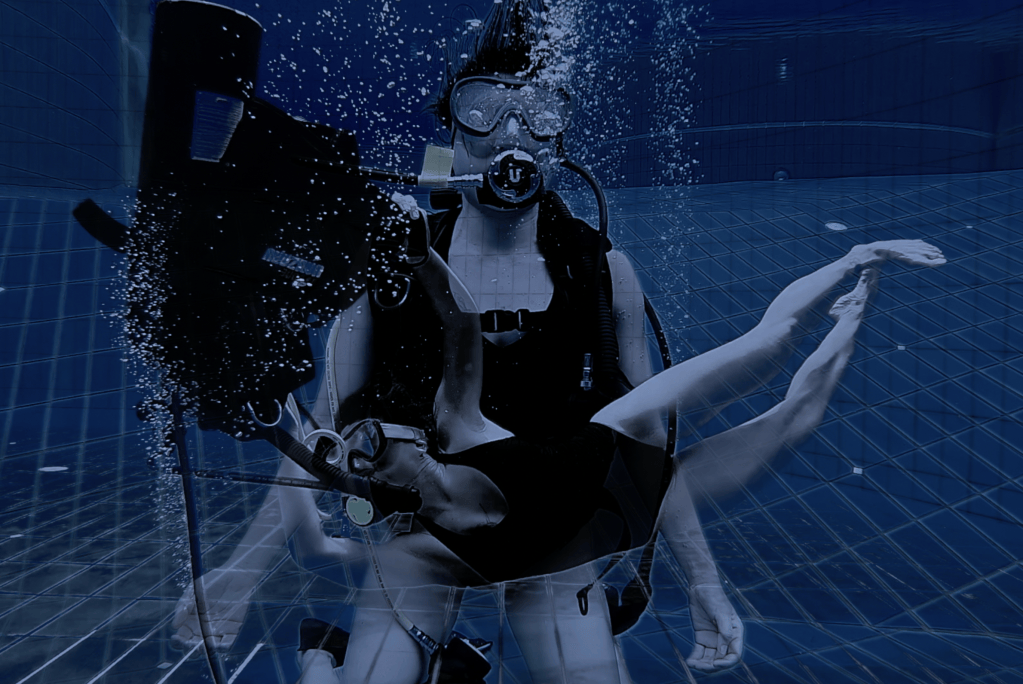
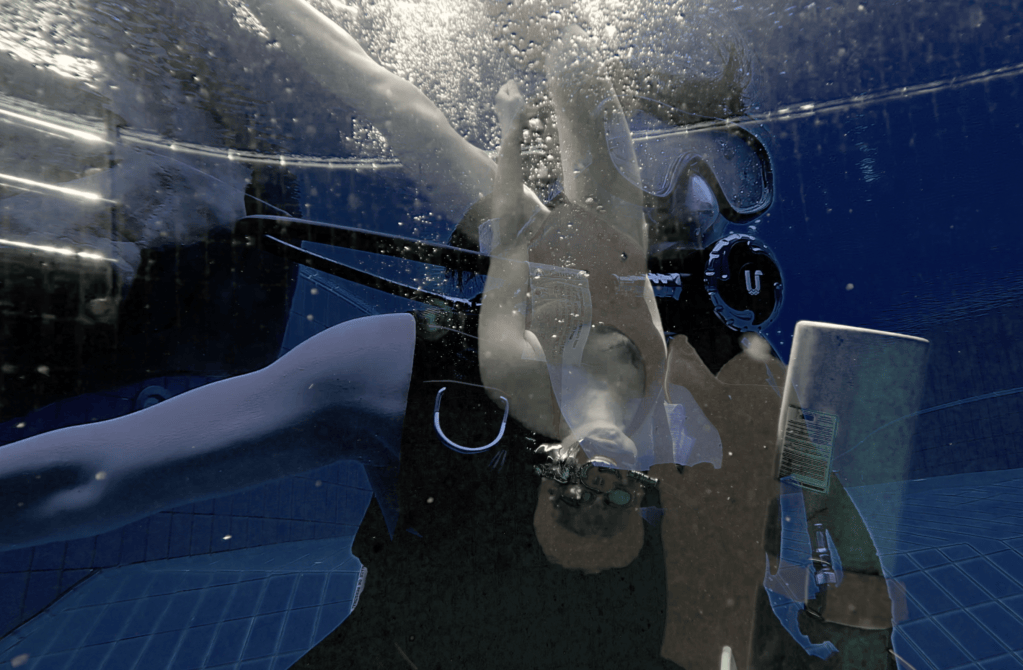
To investigate underwater breathing and movement, I began learning scuba diving and freediving. Scuba diving introduced an external respiratory system through the use of tanks, regulators and tubes.
The scuba apparatus enables the human body to enter and function within an otherwise inaccessible environment. In this sense, technology becomes an extension of the body, allowing the body to breathe beyond its natural limits.
However, the technology also introduces a new dependency. The air tank provides the oxygen necessary for survival, while its finite supply simultaneously establishes a limit to how long the body can remain underwater.
The tank therefore becomes both a mechanism of freedom and a reminder of vulnerability: it enables access to another environment while making the body’s dependence on an external resource explicit.
5. The Lung as Internal Technology
Freediving presents an inverse relationship to scuba diving. Instead of relying on an external air supply, the freediver relies on the capacity of the lungs and the body’s ability to conserve oxygen.
Through freediving, I explored techniques for increasing lung capacity, packing additional air into the lungs and reducing unnecessary physical and mental tension. These practices made her increasingly aware of the relationship between movement, tension, oxygen consumption and duration.
The body itself becomes a form of technology. The lungs function as an internal reservoir, while the body is trained to operate more efficiently within a finite supply of oxygen.
This introduces a tension between bodily discipline and survival: the more efficiently the body uses its resources, the longer it can remain within an environment of constraint.
6. Water and the Transformation of Movement
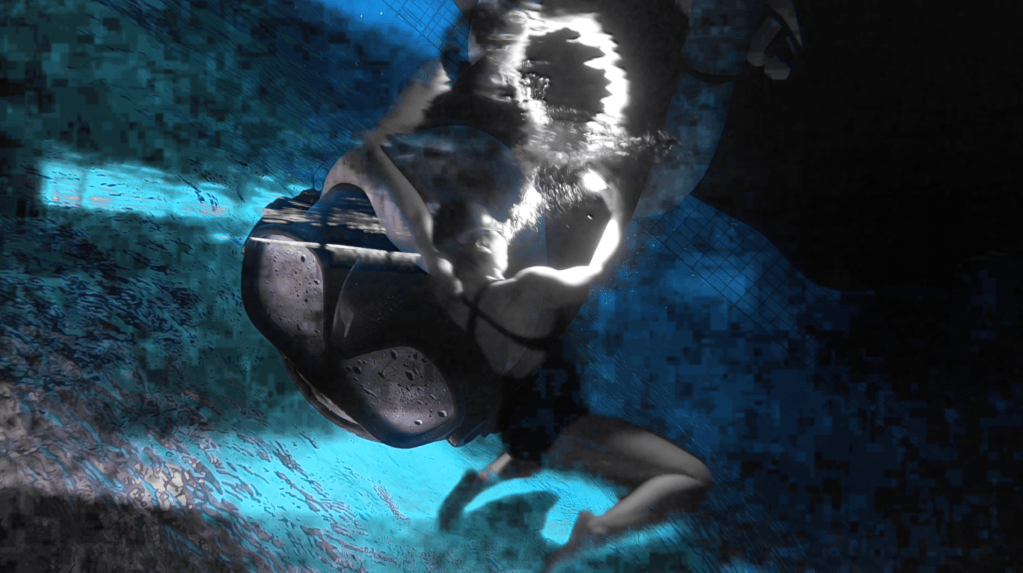
Water does not only alter breathing; it fundamentally changes the body’s relationship to movement and gravity. Buoyancy allows the body to float and experience a sense of weightlessness. Certain movements, such as jumps and leaps, become possible with less effort, while other actions involving weight shifts, balance and control become more difficult. The body must therefore develop a different relationship to gravity, resistance and momentum.
Breathing also becomes part of this physical negotiation. Inhalation expands the body and can increase buoyancy, while exhalation reduces volume and allows the body to sink. Breath consequently becomes both a physiological necessity and a mechanism of movement.
Through this research, I explore how altered environmental conditions can produce new physical vocabularies and forms of performance.
7. Making Breath Visible
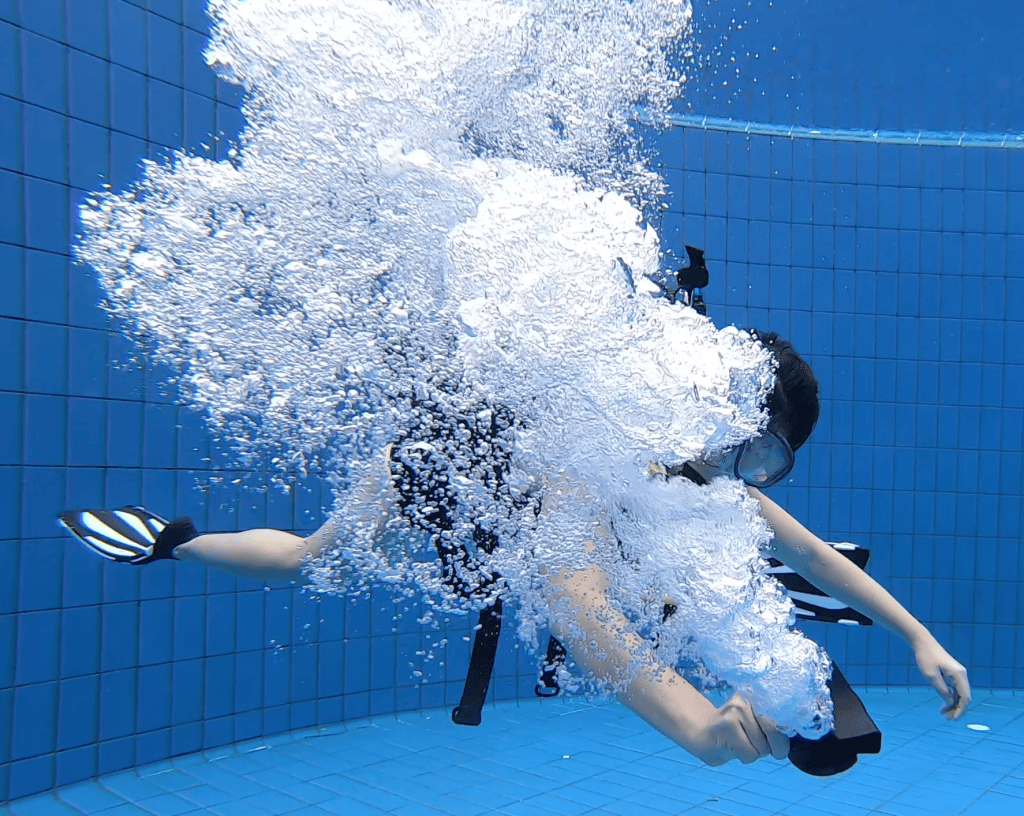
Underwater, exhalation produces bubbles, transforming an invisible physiological process into a visible and audible phenomenon.
This led me to consider the artistic potential of bubbles, air, mist and water as ways of making respiration perceptible.
The experiments with water tanks, air pumps and tubes extend the respiratory system beyond the human body. The installation becomes a system that generates, circulates and releases air, producing bubbles and mist that resemble an externalised respiratory process.
These experiments raise questions about where the body begins and ends. The pump, tube, tank and air supply can be understood as extensions of the respiratory system, creating a distributed relationship between human, machine, water and air.
8. Breath as Restriction and Freedom
Despite the physical restrictions imposed by underwater breath-holding, Toh experienced submersion as producing a quiet mental space during the prolonged isolation of the pandemic.
The act of restricting breath paradoxically became associated with freedom, concentration and reverie.
This contradiction is central to the research. The underwater environment limits the body while simultaneously producing new sensory and psychological possibilities. The finite supply of oxygen becomes both a threat and a condition through which an altered state can be experienced.
Breath therefore operates simultaneously as constraint and possibility, vulnerability and agency, limitation and freedom.
9. Translating Research into Performance
I am now considering how these experiences might be translated into a performance context and shared with an audience.
One possibility is to bring the audience into an aquatic environment, disrupting their familiar relationship to land and movement. Another is to bring underwater technologies onto land, such as a performer moving through a terrestrial environment while carrying an oxygen tank and tube.
These displacements could make the conditions of breathing and oxygen supply newly perceptible.
The research also opens possibilities for working with bubbles, mist, water, sound, tubes and air pumps as performative materials. Rather than representing breath, these materials could create a physical environment in which breath becomes directly experienced.
The research ultimately asks how performance might make visible and tangible the usually invisible systems that sustain the body, and how altered environmental conditions might reveal the body’s dependence, adaptability and capacity for transformation.
 PAT TOH